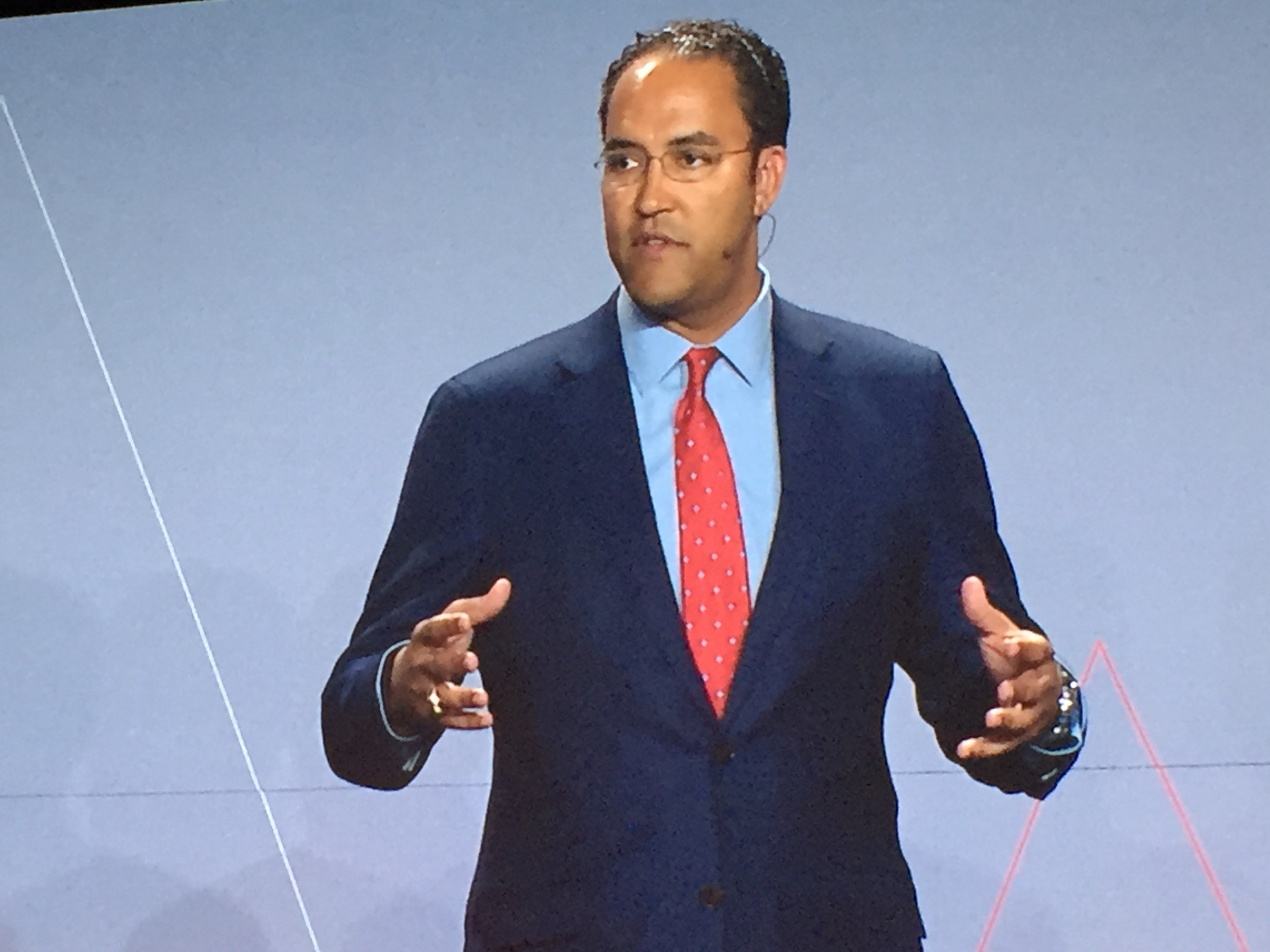
Rep. Will Hurd, R-Texas, took to the stage of the Adobe Digital Government Symposium on a mission to finally deliver agencies a way to upgrade their information technology.
Hours after his Modernizing Government Technology Act was passed out of a House Oversight Committee mark-up, Hurd was on the stump as a keynote speaker at the May 2 conference to tout the bill as a way to solve the federal government's IT problem.
"I always say that IT procurement is not a sexy topic. "Nor would anybody have a rally for IT procurement," he said.
"But if you are in Fort Stockton, Texas — population 2,000 — and you tell them the government spends $90 billion a year on IT procurement and 75 percent of that is on maintaining old and outdated systems, they are immediately outraged."
Hurd reintroduced the bill on April 28 after it unanimously passed the House in 2016 only to get stalled in the Senate.
The bill provides individual working capital funds for each agency to modernize their IT systems, but also sets up a central Information Technology and Modernization Fund and Board to "improve Government-wide efficiency and cybersecurity in accordance with the 15 requirements of the agencies."
Agencies would "reprogram" their own IT funding to apply to their IT modernization efforts, effectively spending their own money on upgrade projects through individual accounts, which they would have access to for three years.
The central fund — along with an Information Technology Modernization Board to advise it —would establish a revolving pool managed by the General Services Administration and the Office of Management and Budget that agencies would apply to receive monies for certain IT projects.
The Texas Republican said the new version of the bill addressed issues that stalled momentum last year, namely a December Congressional Budget Office assessment that it would cost $9 billion to implement, and was actively crafted with the assistance of the White House’s Office of American Innovation.
But a panel on IT modernization appearing at the Adobe conference speculated on whether the MGT Act would go far enough to empower chief information officers to upgrade their agencies’ IT.
"I think they’ve got half of it right at this point, having a capital fund where you can park the money," said Roger Baker, former CIO for the Department of Veterans Affairs. "One of my biggest winges, having been in government, was in 2010. We saved about $373 million and tried to carry it over into 2011 and that got taken back in a rescission, even though I had carryover authority.
"So now that you have got the vehicle there, you’ve got to give CIOs ways to save the money."
Baker said that despite the authority CIOs were given as part of the Federal Information Technology Acquisition Reform Act, they still don’t own the IT funding and need more authority to shutdown failing projects to find the savings for MGT projects.
"Let’s talk about putting in place something that enables — if it’s not stopping a program, it’s cutting back the spend — something that demonstrates that a program that’s been developing for five years and has delivered nothing may have some problems."
Acting Department of Commerce CIO Rod Turk said the MGT would likely have a couple of "unintended consequences, mostly centered around the budgeting of the central fund, which agencies can draw from, but have to pay back.
"In order to get the money, you are going to have to a program in there," he said. "You are going to have to go before a board and say, ‘I’m going to spend the money for this, this is how I’m going to do it, here’s the timeline,’ and at the end of that, you are going to have to pay the money back, which means you are going to have to put this into your budget process.
"So I’m thinking that even though that this is a technology discussion, it’s going to drive some positive behaviors when it comes to the planning process as well as budgeting process as it moves forward."
Turk added that he hopes that MGT will create a broader conversation about the program management, project management and budget facets of these IT projects for better solutions across government.
The MGT Act will next head to the House for a vote.