The House overwhelmingly passed a $480.9 billion budget for the Department of Veterans Affairs, military construction and other programs for fiscal 2027 that included full funding for veterans health care and benefits.
The bill, which also provides appropriations for veterans-related agencies such as the American Battle Monuments Commission and Arlington National Cemetery, includes nearly $450 billion for the VA in fiscal 2027, a 3% increase from fiscal 2026 but lower than President Donald Trump’s request of $488 billion.
The bill was the first appropriations legislation to clear the House this year, in a 400-15 vote May 15 that Rep. John Carter, R-Tex., called a “testament to America’s commitment to taking care of the men and women who have bravely worn the uniform.”
“I want every service member and veteran to know that this bill has their back,” said Carter, chairman of the Military Construction, Veterans Affairs and Related Agencies Subcommittee.
The bill includes $324 billion in mandatory spending for the VA that covers health care and benefits and $137.8 billion for discretionary spending, roughly 2% higher than the fiscal 2026 amount but significantly lower than Trump’s request of $205.6 billion for discretionary funds.
The White House had asked to shift mandatory funds marked for injuries or illnesses related to toxic exposures — roughly $52 billion — to the discretionary budget, but the committee rejected the idea.
Lawmakers have expressed concerns that the use of those mandatory dollars, from the Cost of War Toxic Exposures Fund, would jeopardize the fund’s intended use for veterans sickened by environmental pollutants.
The bill provides $19.7 billion for military construction projects, including $2.1 billion for the Army; $5.5 billion for the Navy and Marine Corps; $3.7 billion for the Air Force; $3.8 billion Defense Department-wide and additional funding for the National Guard and Reserve components.
The bill also includes a provision that would cement the VA’s decision to halt notifications to the Justice Department of a veteran’s inability to manage his or her finances — a situation that precluded veterans with fiduciaries from owning guns.
The Senate still must craft its own version of the bill, referred to as the MilConVA bill. The subcommittee responsible for the legislation jump-started that process in separate hearings April 30 and May 14 on the president’s budget proposals.
During those hearings, senators appeared supportive of the VA budget request and sought affirmation from VA officials that the department use the funds judiciously for health care, claims processing and other veterans services.
Sen. Jon Ossoff, D-Ga., ranking member of the Senate Appropriations MilConVA subcommittee, called the budget proposals “important investments” in the department.
But he expressed concerns about whether the VA had sufficient numbers of physicians and nurses and noted that the budget calls for significant increases for care at private facilities covered by the VA and less of an increase for health care at VA hospitals and clinics.
“The department’s own public facing data shows that outcome for veterans are either the same or better for direct VA care compared to privatized outside care,” Ossoff told VA Secretary Doug Collins in the April 30 hearing.
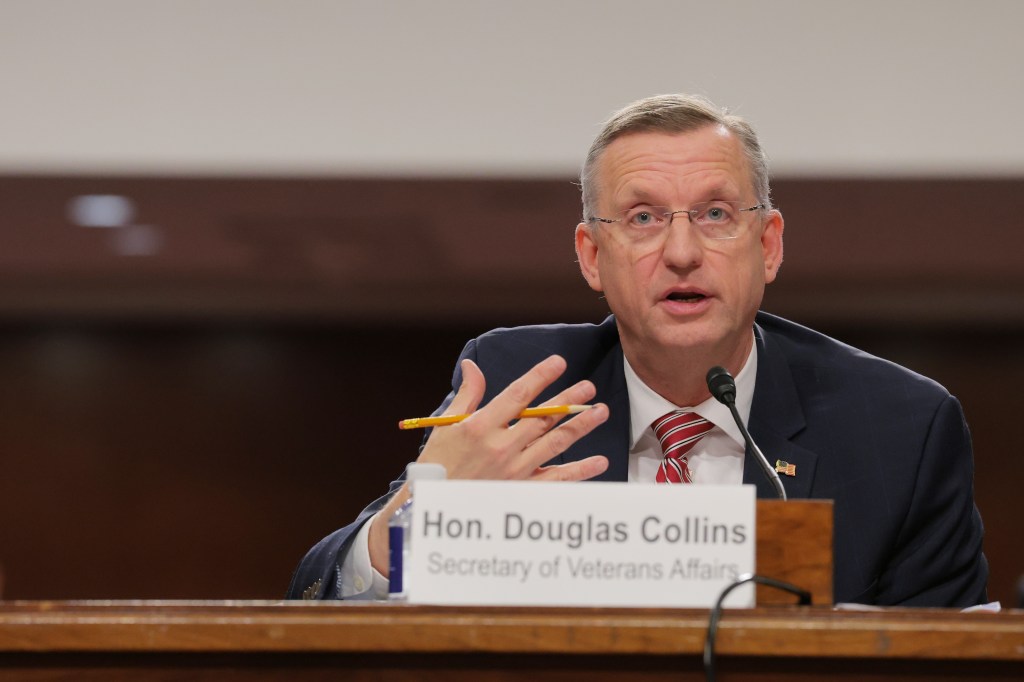
Collins testified Thursday before the House MilCon Appropriations Subcommittee, six days after the House passed its proposed bill.
Collins said that conflicts and the approval process prevented him from testifying until May 21, although earlier in the deliberation process, House Democrats had successfully amended the legislation to withhold 25% of the secretary’s office budget until he testified.
“Our veterans do not deserve that kind of uncertainty and lack of transparency,” said the subcommittee’s ranking Democrat, Rep. Debbie Wasserman Schultz of Florida.
Collins praised the committee for the legislation’s passage and called changes at the VA since he has taken office a “tale of two cities.” He said in the past year the VA has announced a restructuring, instituted a manning document, reduced its disability claims backlog, restarted its VA electronic health records system program and reduced appointment wait times.
“The VA will never be perfect and neither will its budget, but we are always going to work together to make sure one thing is true: Veterans are always going to come first at the VA,” Collins said.
The Senate is expected to roll out its MilConVA appropriations bill this summer.