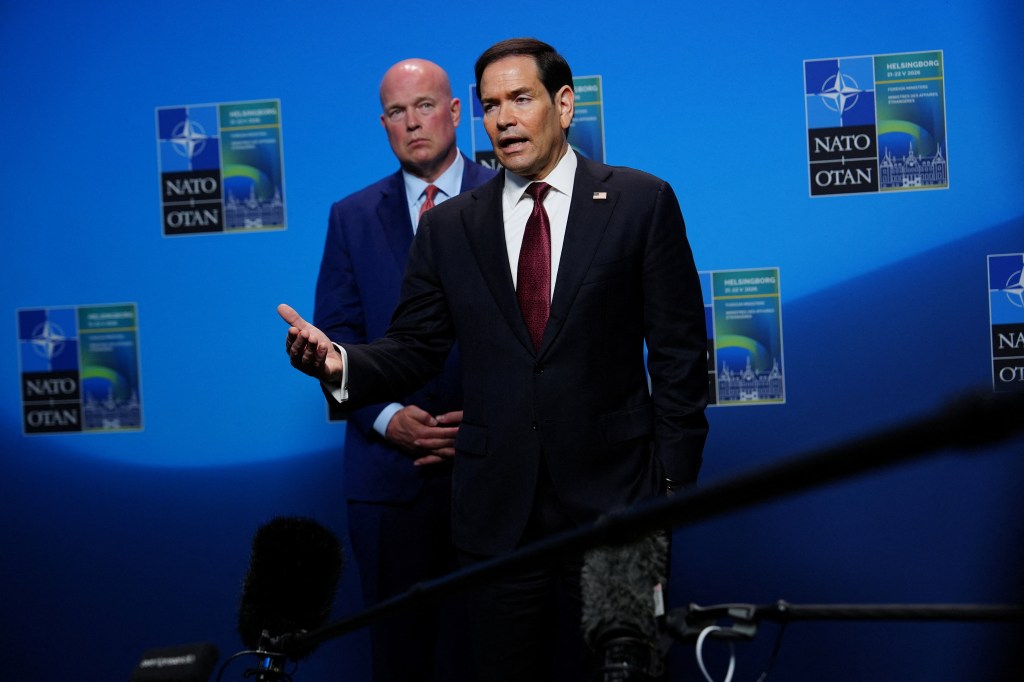
Secretary of State Marco Rubio is casting new doubt on the North Atlantic Treaty Organization’s relevance to the United States after key allies recoiled from backing Washington’s “Operation Epic Fury.”
Rubio, speaking to reporters following a meeting with foreign ministers in Sweden on Friday, contended that the raison d’etre of NATO was undermined when allies refused to allow the U.S. to use installations on their soil during a war.
“One of the arguments I always made was that these bases in the region provided us logistical options that we wouldn’t otherwise have,” Rubio said. “And when some of those bases are denied to you — during a conflict that we’re involved in — then you question whether that value is still there.”
The U.S.-NATO relationship has been increasingly strained in the wake of the war in Iran, which began on Feb. 28. President Donald Trump believes that NATO allies should have offered much more assistance, especially with regard to reopening the Strait of Hormuz. In basic terms, several of those nations say the war, started by Trump and Israeli Prime Minister Benjamin Netanyahu without their consultation, is not their problem.
“I was never swayed by NATO,” Trump said in an interview in April. “I always knew they were a paper tiger.”
In recent weeks, the Trump administration has moved to scale back its military footprint across Europe, a shift Rubio emphasized predated tensions over Iran.
But some contradictory signals have been sent. On Thursday, Trump announced that the United States would deploy 5,000 additional troops to Poland — the same number of troops the Pentagon said earlier this month would be withdrawn from Germany.
Poland’s Foreign Minister Radoslaw Sikorski welcomed Thursday’s reversal, while his Swedish counterpart, Maria Malmer Stenegard, told reporters the U.S. position “is confusing indeed, and not always easy to navigate.”
Rubio, for his part, asserted that the United States military has global commitments in the Indo-Pacific, Middle East and Western Hemisphere that it has to meet — and that this requires a constant reevaluation of force posture.
“It’s well understood in the alliance that the United States’ troop presence in Europe is going to be adjusted,” Rubio said, underscoring that the process is already ongoing. “I’m not saying they’re going to be thrilled about it, but they are certainly aware of it.”
“This is not a punitive thing,” he insisted.
Regardless, Rubio said that Trump’s “disappointment” with the alliance’s response to U.S. operations in Iran will “have to be addressed” at the next NATO leaders’ summit, set for Turkey in July. He suggested that the gathering in Ankara will rank among the most consequential in NATO’s history.